How to Import Sweet Potatoes from Indonesia: A Complete Guide for International Buyers
Discover how to import sweet potatoes from Indonesia for your business. Expert guide covering sourcing, quality, export logistics, and pricing.
Indonesia has become an increasingly attractive sourcing origin for international buyers looking for reliable supplies of sweet potatoes. Its tropical climate, fertile agricultural regions, and established farming communities support the cultivation of several sweet potato varieties throughout the year.
For importers, distributors, wholesalers, and retailers, however, sourcing from Indonesia involves more than finding a supplier and arranging shipment. Product variety, quality specifications, grading, packaging, documentation, shipping conditions, and supplier reliability all need to be considered before placing an order.
Understanding these factors can help buyers reduce sourcing risks, calculate their landed costs more accurately, and establish a supply chain capable of supporting long-term business growth.
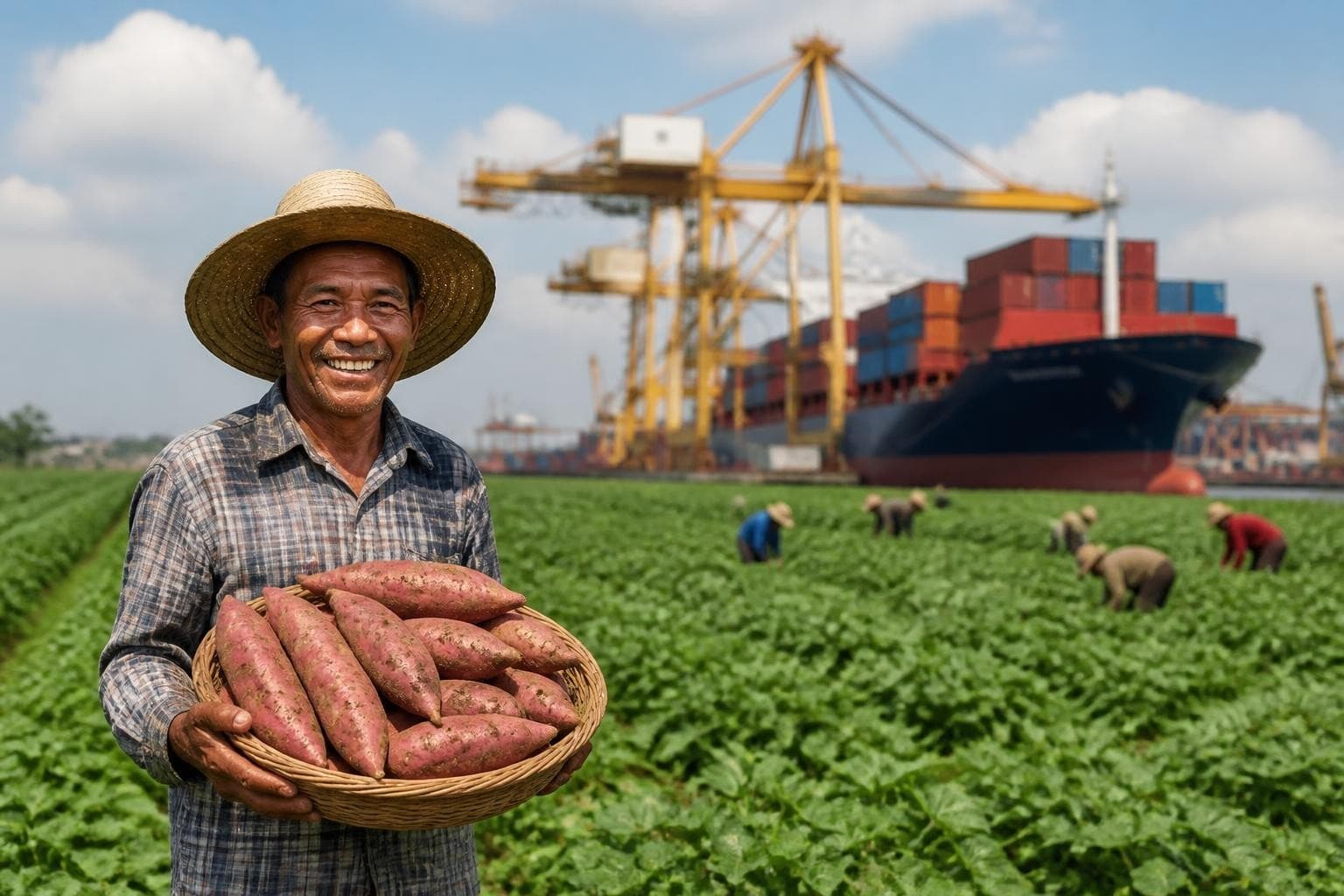
West Java is particularly important for sweet potato production, with a combination of established farming communities and growing export infrastructure. For international buyers, working with an exporter that maintains strong relationships with producing farms can provide greater consistency in product availability and quality.
PT Cakra Baja Niaga works with partner farms in West Java to supply Indonesian sweet potatoes to international buyers, with a focus on product quality, reliable supply, and professional export coordination.
This guide explains the key considerations when importing sweet potatoes from Indonesia, from selecting varieties and establishing quality specifications to packaging, documentation, shipping, and building a long-term supplier relationship.
Indonesia's Sweet Potato Export Landscape
Indonesia's position as a sweet potato sourcing origin is supported by its diverse agricultural regions and favorable growing conditions. West Java is one of the country's important production areas, where traditional farming knowledge is increasingly combined with more structured cultivation and post-harvest practices.
When you import sweet potatoes from Indonesia, you are effectively connecting with a supply chain that can link local farming communities with international markets. This creates opportunities for buyers seeking both conventional and specialty varieties for retail, foodservice, and food manufacturing applications.
Key Export Markets
Indonesian sweet potatoes have opportunities across several international markets, particularly within Asia and other regions where demand for specialty fresh produce is growing.
Potential markets include:
-
Japan — premium fresh produce and specialty varieties
-
Malaysia — retail, wholesale, and foodservice
-
Singapore — retail and food distribution
-
Middle East — growing demand for imported fresh produce
-
Other Asian markets — opportunities for both conventional and specialty varieties
Export volumes and buyer requirements can vary from season to season. For this reason, importers planning regular purchases should work with suppliers capable of coordinating production and availability rather than relying solely on spot-market purchases.
Sweet Potato Varieties Available for Export
Indonesia produces several sweet potato varieties, each with different characteristics, flavors, colors, and potential applications.
Choosing the right variety should be based on the intended market rather than simply the availability of the product.
Popular Varieties from West Java
| Variety | Flesh Color | Flavor Profile | Typical Applications |
|---|---|---|---|
| Cilembu | Orange | Sweet and creamy | Fresh retail, roasting, baking |
| Purple Sweet Potato | Deep purple | Mildly sweet, distinctive | Retail, desserts, food manufacturing |
| Japanese Murasaki | White/cream | Sweet, chestnut-like | Premium retail, specialty markets |
| Honey Sweet Potato | Golden orange | Naturally sweet | Specialty retail and foodservice |
Cilembu is particularly well known for its naturally sweet flavor and smooth texture when cooked. It can be attractive to buyers targeting premium fresh-produce and specialty retail markets.
Purple sweet potatoes offer another important opportunity. Their distinctive color and anthocyanin content make them particularly interesting for premium retail, desserts, beverages, and food manufacturing.
For buyers looking to understand individual varieties in more detail, our guides to Cilembu sweet potatoes and purple flesh sweet potatoes provide additional information.
Quality Standards and Grading
Quality specifications should be agreed upon before an order is confirmed.
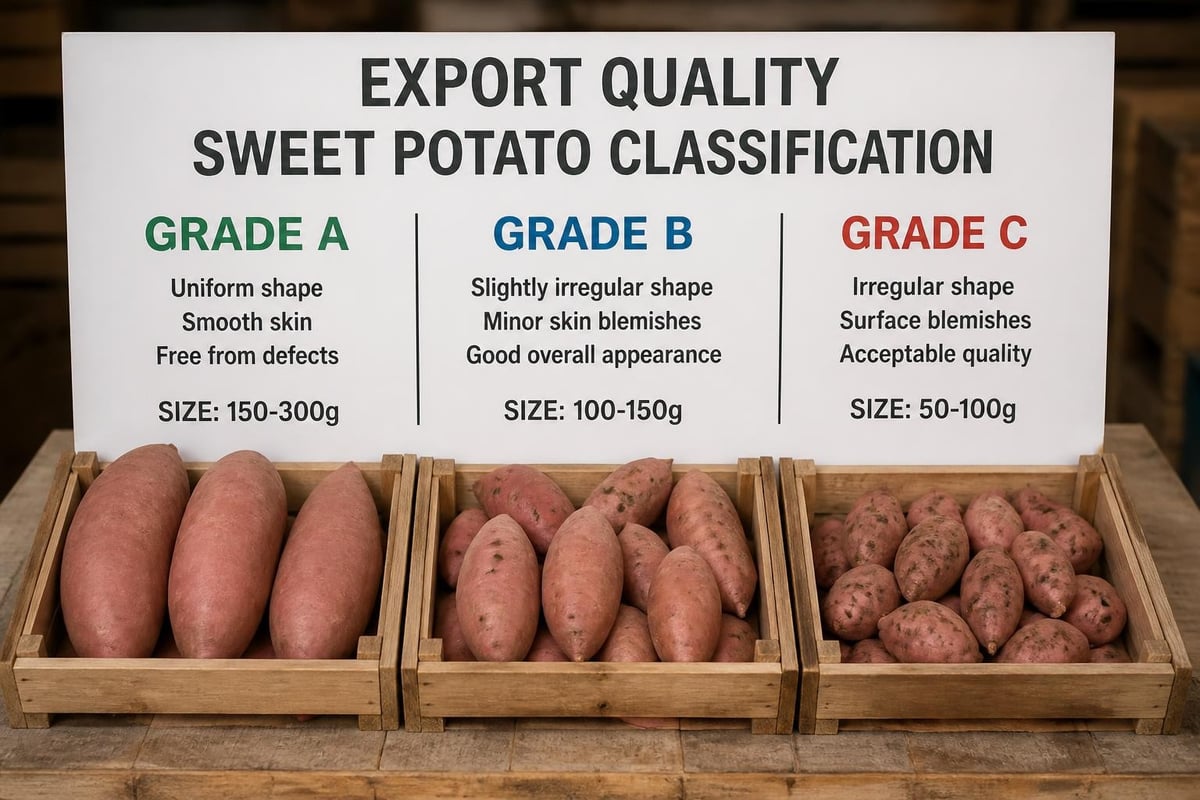
For international buyers, grading helps ensure that the products delivered match the size, appearance, and quality requirements agreed with the supplier.
Grade A — Premium Export
Typically characterized by:
-
Consistent size
-
Smooth skin
-
Minimal cosmetic defects
-
No significant mechanical damage
-
No visible signs of disease
-
Consistent shape and appearance
Grade A products are generally suitable for premium retail and fresh-produce markets.
Grade B — Standard Export
Typically allows:
-
Greater size variation
-
Minor cosmetic imperfections
-
Sound internal quality
-
Minor appearance differences
Grade B products can be suitable for foodservice, wholesale, and certain processing applications.
Grade C — Processing
Products outside fresh-market specifications may still have commercial value when internal quality remains sound.
These products can be used for:
-
Cutting
-
Peeling
-
Puree
-
Flour
-
Chips
-
Other food-processing applications
The exact grading specifications should always be agreed between buyer and supplier because acceptable size ranges and cosmetic tolerances can vary by destination market and application.
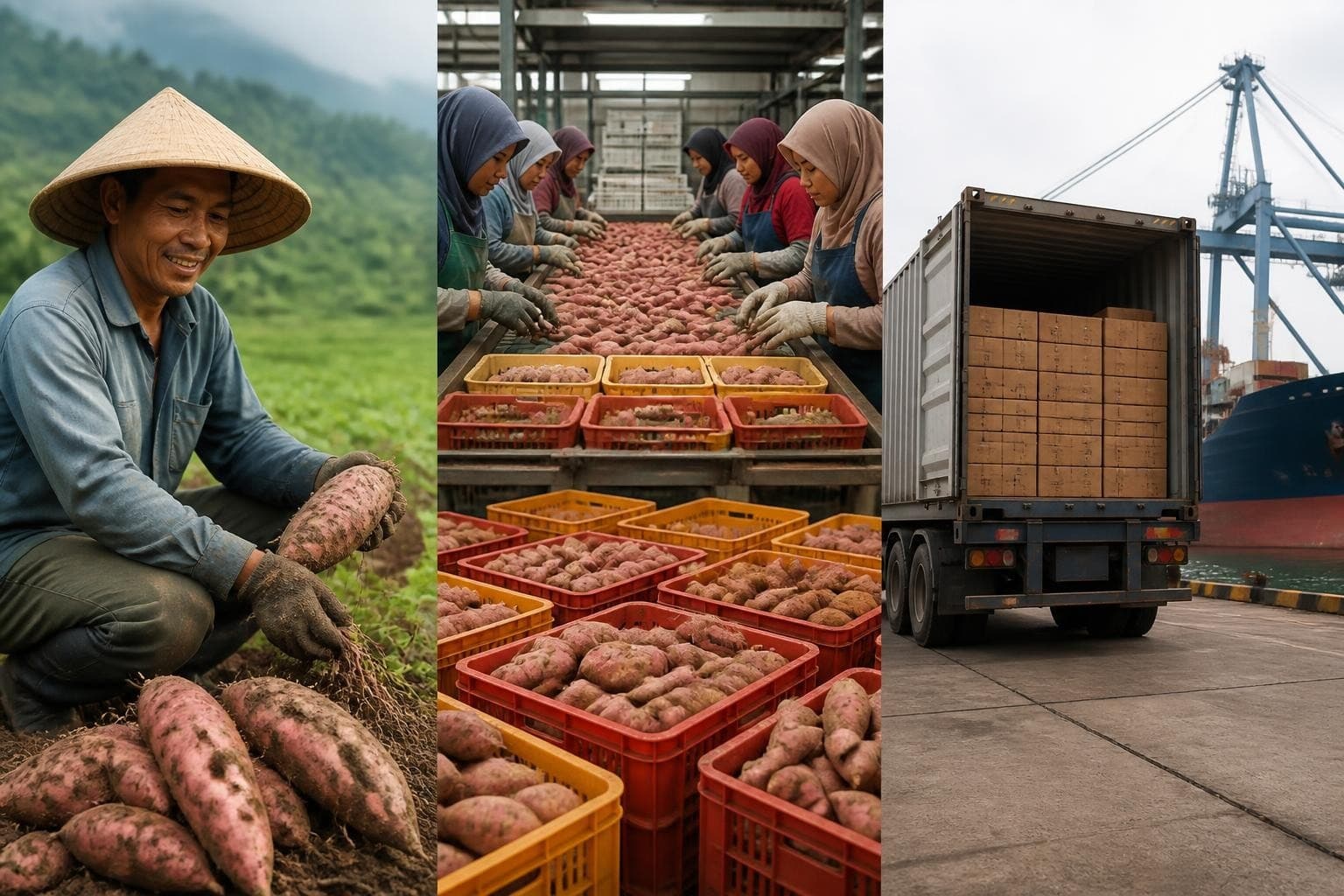
Quality control begins at the farm level. PT Cakra Baja Niaga works with partner farms in West Java and coordinates post-harvest handling, including sorting and preparation for export, to help maintain consistent product quality.
Understanding Sweet Potato Import Pricing
Price is one of the first questions most importers ask, but the purchase price of the sweet potatoes is only one component of the final landed cost.
Prices can change according to:
-
Variety
-
Grade
-
Seasonal availability
-
Order volume
-
Packaging specifications
-
Origin handling
-
International freight
-
Destination charges
-
Certification requirements
The source article cites Indonesian farmgate pricing in July 2026 at approximately USD 0.35–0.75 per kilogram, depending on variety and quality. However, this should be treated as an indicative reference rather than a fixed export price because market conditions change.
Main Components of Landed Cost
When calculating the cost of importing sweet potatoes, buyers should consider:
-
FOB or product price
-
Domestic transportation and handling
-
Export documentation and certification
-
International freight
-
Insurance, where applicable
-
Destination port charges
-
Import duties and taxes
-
Customs clearance
-
Local transportation after arrival
For larger-volume purchases, container shipments can provide better unit economics, although the optimal shipping configuration depends on the destination, packaging, product requirements, and logistics route.
Shipping Sweet Potatoes from Indonesia
International shipping requires careful coordination because sweet potatoes are fresh agricultural products and their quality can deteriorate if handled incorrectly.
Sea Freight
Sea freight is generally the most practical option for commercial-volume shipments.
Advantages include:
-
Lower transportation cost per kilogram at larger volumes
-
Suitable for containerized shipments
-
Regular shipping connections from Indonesian ports
-
Practical for wholesale and commercial orders
Transit times vary considerably depending on the destination, shipping route, port congestion, and transshipment requirements. Buyers should therefore confirm the actual estimated transit time for each shipment rather than relying on a generic figure.
Air Freight
Air freight can be considered for:
-
Samples
-
Small-volume orders
-
Urgent shipments
-
High-value specialty products
The major disadvantage is significantly higher transportation cost compared with sea freight.
For most commercial fresh sweet potato imports, sea freight is likely to be the more economical option.
Documentation and Import Compliance
Agricultural imports require careful attention to documentation.
Depending on the destination country and specific product, buyers may need documents such as:
-
Phytosanitary Certificate
-
Certificate of Origin
-
Commercial Invoice
-
Packing List
-
Bill of Lading or Air Waybill
-
Health or additional certificates where required
-
Fumigation documentation where applicable
Import requirements are determined by the destination country's authorities and can change over time. Buyers should confirm the current requirements with their local agricultural, customs, or food-safety authorities before placing an order.
An experienced exporter can help coordinate the documentation required from the Indonesian side and communicate with the buyer regarding destination-specific requirements.
This is particularly important for markets with strict plant-health and food-safety regulations.
Export Packaging for Sweet Potatoes
Packaging needs to protect the product while also meeting the buyer's handling and retail requirements.
Common options include:
| Packaging | Typical Use |
|---|---|
| Mesh bags | Wholesale and foodservice |
| 5–10 kg cartons | Retail and wholesale distribution |
| 1–3 kg consumer packs | Supermarket retail |
| Bulk packaging | Food processing |
The actual packaging configuration should be agreed before production because carton dimensions, net weight, labeling, ventilation, pallet configuration, and container loading all affect logistics costs.
Good export packaging should provide sufficient protection against:
-
Bruising
-
Compression
-
Excess moisture
-
Rough handling
-
Poor ventilation
For premium varieties, customized packaging and labeling can also help buyers create stronger retail positioning.
PT Cakra Baja Niaga can work with buyers to discuss packaging specifications based on the destination market and intended distribution channel.
Food Safety and Certification
Food safety requirements vary between destination markets, so buyers should establish the required standards before finalizing a supplier.
Potential requirements may include:
Good Agricultural Practices
GAP systems can support:
-
Farm-level traceability
-
Responsible agricultural practices
-
Pesticide-use records
-
Quality management
HACCP
Where processing or packing operations fall within the relevant scope, HACCP principles can help identify and control food-safety hazards.
Organic Certification
Organic certification is relevant when the buyer intends to market the product as organic. Certification requirements must be verified for both the production system and destination market.
For buyers targeting markets such as the European Union or Japan, it is particularly important to confirm current import, pesticide-residue, plant-health, labeling, and certification requirements before shipment.
How to Choose a Reliable Indonesian Sweet Potato Supplier
The supplier you choose can have a greater impact on your long-term sourcing success than a small difference in the initial purchase price.
When evaluating exporters, consider five key areas.
1. Production Capacity
Ask whether the supplier has:
-
Reliable farming partners
-
Multiple production areas
-
Coordinated planting schedules
-
Adequate supply for repeat orders
2. Quality Control
Look for documented procedures covering:
-
Harvesting
-
Sorting
-
Grading
-
Curing
-
Packing
-
Final inspection
3. Export Experience
An experienced exporter should understand:
-
Export documentation
-
International shipping
-
Packaging requirements
-
Destination-market requirements
-
Communication with overseas buyers
4. Transparency
A reliable supplier should be willing to discuss:
-
Product specifications
-
Available varieties
-
Pricing
-
MOQ
-
Production schedules
-
Packaging
-
Shipping arrangements
Providing samples or facilitating farm and facility inspections can also help establish confidence before larger orders.
5. Communication
Agricultural supply chains can change quickly because of weather, harvest timing, logistics, and market conditions.
Fast and transparent communication therefore matters just as much as product quality.
PT Cakra Baja Niaga works with farming partners in West Java and supports international buyers throughout the sourcing and export process, from product specifications and packaging through shipment coordination.
Payment Terms for International Sweet Potato Trade
Payment terms should be agreed clearly before an order is confirmed.
Common international trade structures include:
-
Letter of Credit (LC)
-
Telegraphic Transfer (TT)
-
Documents Against Payment (D/P)
-
Open Account for established business relationships
The appropriate structure depends on the relationship between buyer and supplier, transaction size, risk allocation, and banking arrangements.
For new trading relationships, buyers and sellers generally benefit from using a payment method that provides appropriate protection to both parties.
As the relationship develops and successful transactions build trust, the parties may negotiate more flexible arrangements.
Seasonal Availability of Indonesian Sweet Potatoes
One of Indonesia's advantages is its ability to cultivate sweet potatoes across different regions and planting periods.
However, year-round production does not necessarily mean identical availability every month.
Weather conditions, planting schedules, regional production, and variety all influence:
-
Available volume
-
Product size
-
Quality
-
Pricing
-
Harvest timing
For importers requiring regular shipments, forward planning is therefore important.
Buyers can improve supply reliability by providing forecasts and purchase schedules to exporters in advance. This allows farming partners to plan planting and harvesting around anticipated demand.
PT Cakra Baja Niaga works with partner farms to coordinate supply planning and help international buyers develop more consistent sourcing programs.
Growing Opportunities in the Sweet Potato Market
Sweet potatoes continue to benefit from several broad food-market trends.
Health and Wellness
Consumers increasingly seek nutritious whole-food ingredients, creating opportunities for fresh sweet potatoes and specialty varieties such as purple sweet potatoes.
Foodservice
Restaurants and foodservice businesses use sweet potatoes in:
-
Fries
-
Side dishes
-
Desserts
-
Baked products
-
Specialty menus
Food Manufacturing
Sweet potatoes can also be processed into:
-
Puree
-
Flour
-
Chips
-
Frozen products
-
Natural-color ingredients
-
Other value-added foods
Retail and E-Commerce
Premium varieties can be positioned through supermarkets, specialty retailers, online grocery platforms, and direct-to-consumer channels.
These expanding applications create opportunities for importers that can establish reliable supply relationships with producers and exporters.
Building a Long-Term Sourcing Partnership
The most successful agricultural import relationships are built around clear specifications, consistent communication, and mutual planning rather than individual spot purchases.
Before starting a regular supply program, buyers and exporters should agree on:
Product Specifications
-
Variety
-
Size
-
Grade
-
Appearance
-
Quality tolerances
Packaging
-
Net weight
-
Carton or bag type
-
Labeling
-
Pallet configuration
Commercial Terms
-
Price basis
-
MOQ
-
Payment terms
-
Shipping terms
-
Order schedule
Quality Management
-
Inspection procedures
-
Acceptance criteria
-
Documentation
-
Procedures for handling quality claims
When both sides have clear expectations, the relationship becomes easier to manage and the risk of misunderstandings is reduced.
Frequently Asked Questions
Can I import sweet potatoes directly from Indonesia?
Yes. International buyers can source sweet potatoes directly from Indonesian exporters. Direct sourcing can be particularly attractive for wholesalers, distributors, retailers, and food manufacturers purchasing commercial quantities.
What sweet potato varieties can I source from Indonesia?
Depending on availability and market requirements, Indonesian suppliers can offer varieties such as Cilembu, purple sweet potatoes, Japanese Murasaki, and other locally cultivated varieties.
What is the minimum order quantity?
MOQ depends on the variety, grade, packaging, destination, and shipping method. Buyers should discuss their required volume with the exporter before receiving a quotation.
How are sweet potatoes shipped internationally?
Commercial shipments are generally transported by sea freight, while air freight can be considered for samples, urgent orders, or smaller premium shipments.
What documents do I need to import sweet potatoes?
Requirements vary by destination. Common documents include a phytosanitary certificate, commercial invoice, packing list, certificate of origin, and shipping document. Additional requirements may apply depending on the importing country's regulations.
How can I get a quotation from an Indonesian exporter?
Provide the exporter with your preferred variety, required grade and size, packaging requirements, estimated quantity, destination port, and desired delivery schedule. This allows the supplier to prepare a more accurate quotation.
Conclusion: Building a Reliable Sweet Potato Supply Chain from Indonesia
Importing sweet potatoes from Indonesia can provide international buyers with access to competitive pricing, diverse varieties, and a growing agricultural supply base. However, successful importing depends on much more than finding a low product price.
Buyers should evaluate the complete supply chain—from farm production and quality control to packaging, documentation, shipping, and supplier communication.
The strongest sourcing relationships are built around clear specifications, reliable supply planning, transparent communication, and consistent quality.
For international buyers looking for a dependable Indonesian sourcing partner, PT Cakra Baja Niaga works with partner farms in West Java to supply export-quality sweet potatoes for wholesale, retail, foodservice, and food manufacturing applications.
Looking to import sweet potatoes from Indonesia? Contact PT Cakra Baja Niaga to discuss your required variety, specifications, packaging, volume, and destination. Our team can help you develop a sourcing solution suited to your market.
Looking to source premium Indonesian sweet potatoes?
PT Cakra Baja Niaga supplies export-grade Cilembu, Purple, and Murasaki varieties to buyers worldwide.
Continue reading
Wholesale Sweet Potatoes Indonesia: B2B Export Guide 2026
Source premium wholesale sweet potatoes Indonesia for import. Quality standards, export logistics, varieties, pricing & supplier partnerships.
Read article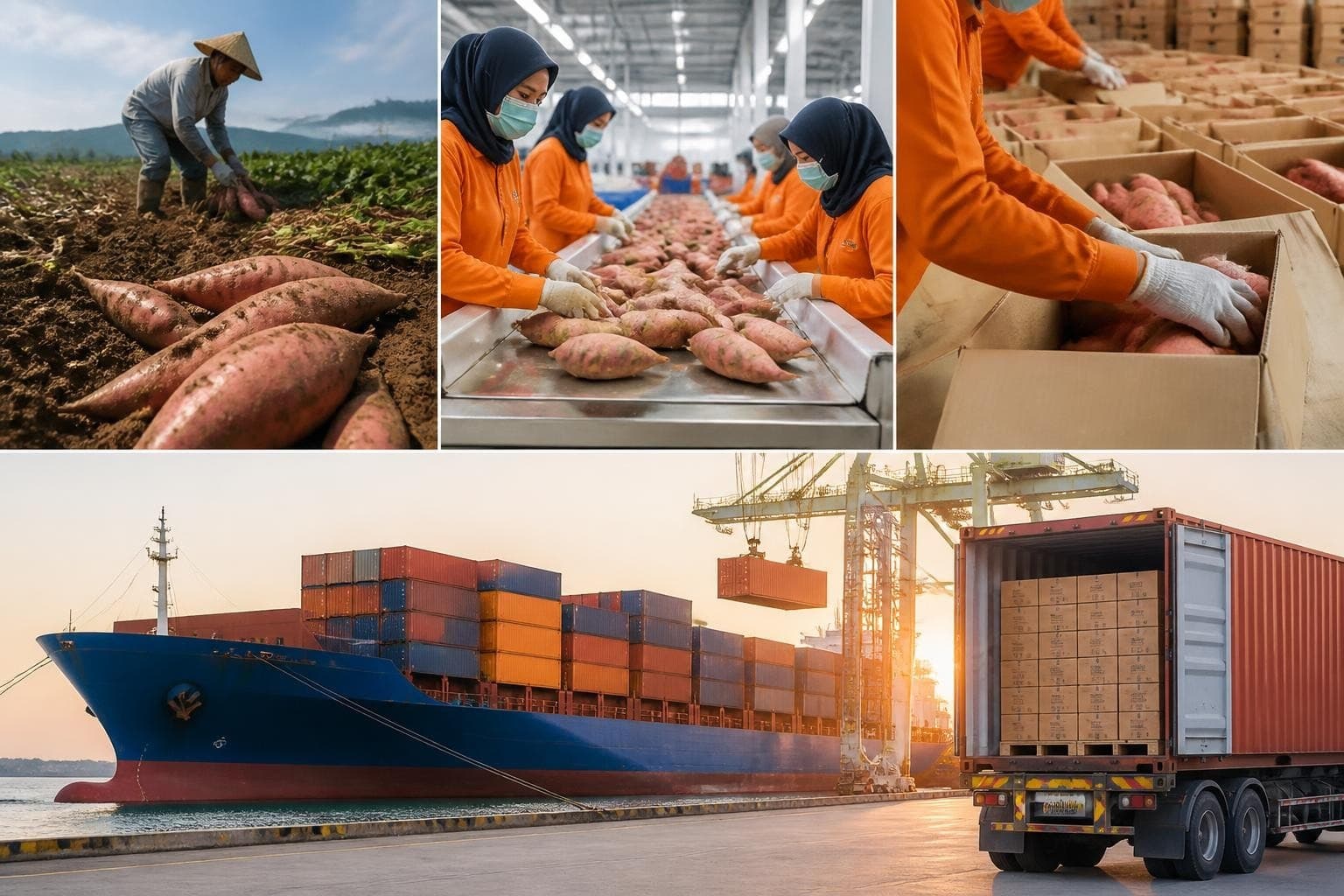
Sweet Potatoes Supplier Indonesia: Quality & Export Guide
Find reliable sweet potatoes supplier Indonesia offering premium export quality. Learn about sourcing, grading, logistics, and partnerships.
Read article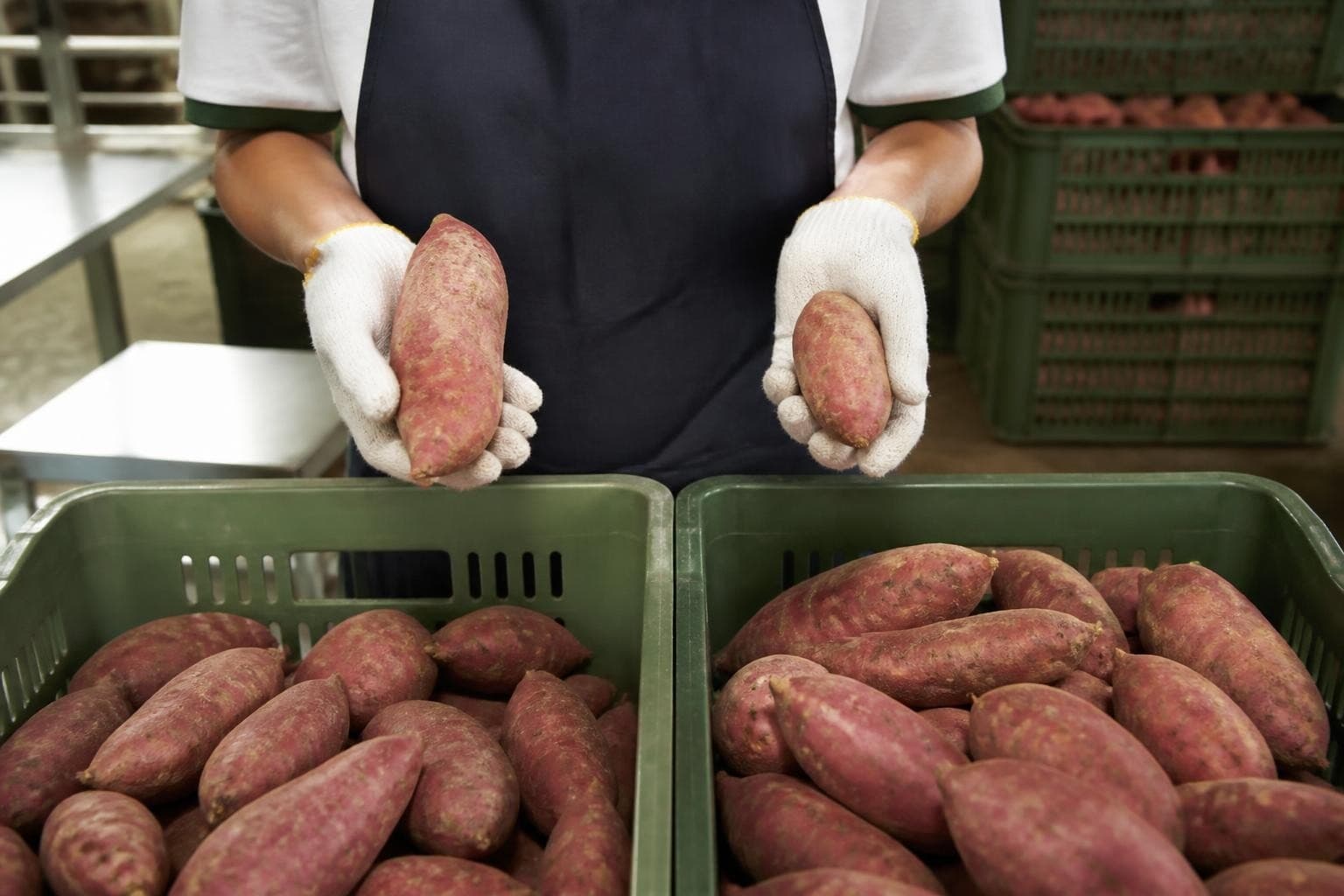
Sweet Potatoes Grading Guide for International Buyers
Comprehensive sweet potatoes grading guide for exporters and importers. Learn USDA standards, size classification, defect tolerance, and quality control.
Read article